
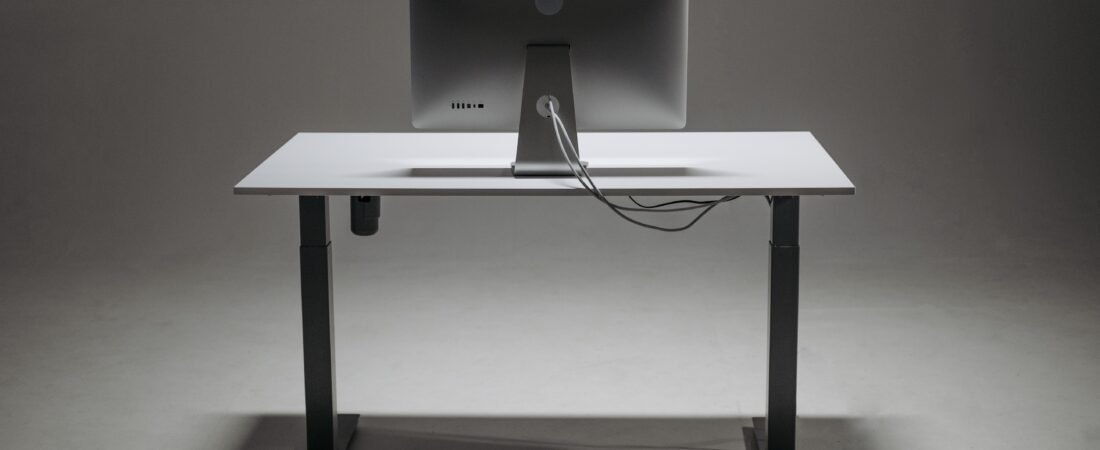
All you need to know about buying a standing desk in Australia!
When I was looking for a standing desk, most of the guides were for desks sold in America. None of us here in Australia want to pay shipping on a heavy desk! So I wrote this guide for the standing desk market in Australia. It covers everything you need to know about buying a standing desk that suits your space and needs.
All prices on this page are listed in Australian dollars (AUD).
If you’re short on time
Our top recommendations for Australia
Prices are shown in Australian dollars. As an Amazon Associate, we earn from qualifying purchases.
Top pick
FlexiSpot E7 Pro standing desk
With a dual motor and a 160kg weight capacity, this desk suits serious home office setups.
Price $535 AUD
Buy nowBest budget option
BilySen electric standing desk
This desk suits people roughly 120 to 183cm tall and has a weight capacity of 70kg, making it a great budget option.
Price $110 AUD
Buy nowShortlist: recommended standing desks
| Desk | Motor | Budget | Height range | Suits height | Desk dimensions | Capacity | Price (AUD) | Link |
|---|---|---|---|---|---|---|---|---|
| FlexiSpot E7 Pro standing desk | Dual motor | $$$ | 63.5-128.5cm | 106-204cm | 140 x 70cm | 160kg | $535 | Buy now |
| FlexiSpot E6 standing desk | Dual motor | $$$ | 60-125cm | 100-198cm | 160 x 80cm | 100kg | $458 | Buy now |
| Fezibo electric standing desk | Single motor | $$ | 71.9-118.1cm | 120-187cm | 120 x 60cm | 80kg | $160 | Buy now |
| Claiks electric standing desk | Single motor | $ | 72-118cm | 120-187cm | 100 x 60cm | 80kg | $130 | Buy now |
| Uptyia manual standing desk | Manual | $ | 62.5-89.4cm | 104-142cm | 60 x 80cm | 125kg | $120 | Buy now |
| BilySen electric standing desk | Single motor | $ | 72-115cm | 120-183cm | 120 x 60cm | 70kg | $110 | Buy now |
What to look for in a standing desk
Height range of the standing desk
Your desk should sit at about your standing elbow height, with your elbows bent at roughly 90 to 100 degrees.
To find your ideal standing desk height, stand in your usual work shoes, relax your shoulders and bend your elbow to about 90 degrees. Then measure the distance from the floor to the bottom of your elbow.
Ideally, the desk should reach at least 5cm below your seated elbow height and at least 5cm above your standing elbow height.
This depends on other factors, such as posture, so choose the desk that is most comfortable for your circumstances.
If you want a quick rule of thumb, standing elbow height is about 60 to 63% of your standing height. That means you’re looking for a desk that adjusts to around 96 to 101cm for a person who is 160cm tall, or 102 to 107cm for someone who is 170cm.
For example, the FlexiSpot E7 Pro has a height range of 63.5 to 128.5cm, so as a standing desk, it would typically suit someone who is about 106 to 204cm tall. That range does not account for seated height, so check the lowest setting against your seated elbow height.
Dual motor or single motor standing desks
Motor type affects how the frame moves each time you change between sitting and standing.
A single motor drives both legs through a single crossbar, which can cause uneven movement and wobble at full height under load.
A dual motor desk gives each leg its own motor, so it moves more evenly.
As you’d expect, a dual motor desk uses twice as many motors, so single motor desks are often more affordable.
Electric vs manual standing desks
A manual desk changes height with a hand crank or similar mechanical system, while an electric desk uses a motor and a control panel. A person of average fitness won’t find a manual standing desk difficult to operate.
Electric desks are faster (unless you’re super speedy with a hand crank!) and need less physical effort. Electric desks typically move at around 2.5 to 5cm per second.
Electric desks usually cost more upfront, while manual desks are usually simpler and more affordable.
Electric desks also need a power point nearby, which can limit where you can place the desk in a small room. Australian power points supply 230 volts and take a three-pin plug. Hand crank desks often have a lower weight capacity than electric desks.
For a small home office, an electric desk suits people who change position often. A manual desk can suit a small apartment, or where you don’t want electric components that could break.
Another benefit of electric desks is that they often have presets, so you can save your height settings instead of setting the height by hand each time. Save two to four positions, such as seated, standing and in between.
How much weight the standing desk can carry
A regular desk only has to hold its load while it stays still. A standing desk has two limits to check: the static limit and the lifting limit.
The static limit is the most weight the desk can support when it is stationary. The lifting limit is the most weight its motors can safely raise and lower across the full height range.
Everything on or attached to the desk surface counts toward the limit, including monitors, arms and accessories. Check the manual to see whether the listed figure includes the desktop itself, as sometimes it doesn’t.
Most standing desks are designed to hold at least a laptop and a monitor. Single motor desks usually have a lower lifting limit than dual motor desks, since one motor lifts the whole load.
Single motor models typically have a lifting limit of 68 to 91kg, while dual motor models often start at about 100kg.
A common guideline is to keep the load below about 80% of the rated capacity, just to be on the safe side. Running a desk above that level can increase motor strain and reduce stability. An unbalanced load can also reduce stability, especially at full standing height, so you don’t want your precious equipment going flying!
Standing desk dimensions
This may sound obvious, but measure the spot where your desk will go before you buy it! Leave a little room between the desk and nearby objects, as the desk will move up and down.
Conclusion
Here’s a summary of the key points to consider before buying a standing desk.
- Height range: Check that the desk reaches your standing elbow height, which is roughly 60 to 63% of your standing height.
- Motor type: A dual motor desk gives each leg its own motor, which makes movement more stable. Single motor desks are often the more affordable option.
- Electric or manual: Electric desks adjust at the press of a button but need a nearby power point. Manual desks use a hand crank and are usually the more affordable choice.
- Weight capacity: Consider how much you’ll store on your desk. A common guideline is to keep the load below about 80% of the rated capacity.
- Desk dimensions: Measure the spot before you buy, and leave room between the desk and nearby objects, since the desk moves up and down.
- Budget: Prices for standing desks in Australia range from $110 to $535 AUD. Single motor and manual desks are usually the lower-priced options.
Related guides
- Standing desk buying guide: height range, motors, stability and weight limits.
- Best small monitors: size, resolution and ports.
- Best webcam for remote teaching: picks by use case.
As an Amazon Associate, we earn from qualifying purchases. Prices are in AUD and can change, so check the product page before you buy.